Optable Blog
Learn about the agentic advertising landscape and how Optable's solutions can help your business.

Once you know what an agent-ready identity foundation looks like, the next step is to determine where your own graph stands and which gap you need to close first.
Strengthening your identity foundation rarely means starting over. Most publishers already own the raw material: logins, newsletter lists, subscription records, and first-party events. Becoming agent-ready is a matter of putting that material to work, beginning with an honest read on where your data currently stands.
1. Know Your Numbers
Before changing anything, record where you stand on four measures:
- Authentication rate: How much of your traffic comes from readers who are logged in or known by email. Pull it from your analytics or login system, and break it out by property, since rates can vary widely from one site to the next.
- Unification rate: How many profiles have been matched across properties and sources. If your newsletter platform and login database each count a million readers, this number reveals how many people that really is.
- Addressable share: The portion of your audience you can resolve to the ID frameworks buyers activate on. Readers outside it can't be reached beyond your own properties.
- Consent coverage: Check what your data is consented for, then measure how much of it covers activation, including uses an agent would need, such as being queried or packaged for outside buyers.
A publisher that's ready for agents looks noticeably different from one that isn't:
2. Connect What You Already Collect
If your newsletter list, login database, and subscription records have never been matched to one another, unifying those profiles is your immediate next step.
Matching on a shared key is the core of any first-party identity graph. A hashed email address is the most common key, since many readers use the same address for a newsletter, an account and a subscription. Records that share a key collapse into one profile, and profiles that share a household can be grouped above that. Resolution then maps each profile to the ID frameworks your buyers' platforms use.
Expect a few snags along the way. The same reader may sign up with a work email in one place and a personal one in another. Old records linger after readers unsubscribe or let a subscription lapse. And data collected under different consent terms can't always be merged freely, so check what each source permits before you combine it.
3. Grow Your Audience
Every reader who logs in or shares an email becomes a profile you can count, resolve and offer to buyers, so growing that known audience is the most direct way to deepen your graph. For visitors using a browser that blocks third-party cookies, a login is often the most stable identifier you have.
Growing that audience starts with giving your visitors a reason to sign in. News readers sign up for alerts and briefings on the topics they follow. Lifestyle readers save recipes, lists and guides. Sports and gaming audiences pick favorite teams or titles to shape what they see. In every case, the login has to pay the reader back right away.
Friction matters as much as the offer. Single sign-on across your properties means a reader logs in once instead of once per site, and passwordless options like emailed sign-in links remove a step that loses readers. Measure each change against the authentication rate you recorded in step one.
4. Set the Rules Before Agents Arrive
Agents act on the rules they're given, and they can't stop to ask a follow-up question. Clear consent and usage rules are what let an agent move quickly without putting your readers' trust or your business at risk. Review consent language with Legal against agentic use cases, then attach usage rules to each profile so an agent never has to guess.
Most consent language was written for the way data was used when readers signed up. Agentic use cases raise new questions. Can a buyer agent query this data? Can audiences built from it be shown to outside buyers before a deal is signed? Can it be activated through a partner's platform? Record each answer on the profile itself, along with where the data can go and for how long.
This is an area where publishers can get ahead. In the State of Agentic Advertising survey, 56% of respondents named governance and auditability among the least-invested areas of agentic advertising. With comprehensive privacy laws now in effect in 20 US states, clear rules double as a compliance safeguard. Legal's part in this work is one reason agent readiness takes the whole organization. Nothing here is legal advice; your counsel should set the rules for your business.
5. Rollout Changes in Phases
Opening your graph to everyone at once makes problems hard to trace. A phased rollout shows you how the graph holds up before outside buyers and agents depend on it. How easily other systems can reach and act on your data is its own measure of readiness:
Phase 1: Internal Tools
Start with the people who already know your audiences. Make the graph queryable by API for your own tools first so teams can size segments, answer RFP questions and check consent status without an export. Watch which questions come up most and which answers come back slow or incomplete. Those are the gaps a buyer agent would find first.
Phase 2: Partners
Next, open access to a small set of partners you already trust, such as an SSP or a data partner. This is where resolution gets tested: confirm your audiences match on the ID frameworks those partners use, and that consent rules travel with the data. Run the same audience as a direct order and as a programmatic deal, such as a PMP or programmatic guaranteed deal, to make sure both paths work.
Phase 3: Agents
Then, it’s time to let agents in. A seller agent can represent your audiences to buyer agents, and the deals they reach can land as direct orders or programmatic deals. Decide up front what an agent can see, what it can commit to without a person, and how your team reviews what it did. By this point, you'll know how the graph holds up under real questions, and your agents start from that footing.
Should You Build, Buy, or Partner?
Not every publisher has the capacity in-house to handle all the engineering required to become agent-ready. In the State of Agentic Advertising survey, 68% of publishers named technical complexity as a barrier to leaning into agentic demand. Building, buying, partnering, or a mix of all three are valid paths. A partner can take on unification, resolution, and enrichment while your team keeps ownership of the data and the rules around it.
The right mix comes down to a few factors: how much engineering time you can dedicate, how quickly you need results, and how many ID frameworks your buyers expect you to support. Building gives you the most control but takes the longest. Buying tools your team runs speeds things up but still needs people to operate them. Partnering moves fastest, as long as ownership of the data stays with you.
Whichever path you choose, a few questions will tell you whether it fits:
- Who owns the graph and the data in it if the relationship ends?
- Which ID frameworks does it resolve to today, and how are new ones added?
- How do consent and usage rules travel with the data once it leaves your systems?
- Can it support direct and programmatic activation, with agentic deals on top of both?
Finish the Foundation You Started
For most publishers, achieving agent readiness is the last stretch of work already underway: a measured baseline, connected profiles, more known readers, clear rules, and access opened in the right order.
Once that foundation is in place, put it to work with Optable's agentic tools. Optable Audience Agent turns a brief into audience segments drawn from your graph. Optable Sales Agent represents your inventory to buyer agents, and the Agentic Marketplace lets those agents place orders directly while you keep control of pricing and approvals.
If you're working out where your data stands today, let’s walk through what we can build together. Talk to our team.

A buyer agent can only evaluate what your data can describe, and a seller agent can only represent what your data supports. Underneath both is the knowledge of who your readers are across every property and device and what you have permission to do with that information.
In our State of Agentic Advertising Report with Digiday, we asked publishers which capabilities matter most over the next 12 months. Nearly half (49%) chose improving first-party data and signals so AI agents can discover them. Only 5% chose building seller-side agents. The foundation comes first, and for most publishers, that foundation is identity.
What an Agent-Ready Identity Foundation Looks Like
At the center of the foundation sits a first-party identity graph. Agent readiness asks more of the graph than most publishers have needed so far, because a buyer agent queries it directly, at machine speed, with no sales conversation to smooth over the gaps.
For an identity graph to be agent-ready, it needs the following:
- Unified first-party data: Logins, newsletter signups, subscriptions, app events, and CRM records come together in one profile per reader or household. That single view gives every audience an accurate count of real people and a full picture of how each reader engages across your properties.
- Identity resolution: A buyer agent transacts on the ID frameworks its own platforms support. Resolution links your profiles across devices and identifiers, then maps them to those frameworks, so an audience built on your properties can be activated outside them.
- A growing authentication rate: Known readers anchor everything else. An increased authentication rate, meaning the share of traffic that is logged in or known by email, gives the graph its depth.
- Consent attached to each profile: An automated deal can't pause to consult the Legal team. When consent travels with each profile, documenting what it can be used for and where, the question gets answered before it’s asked.
- Real-time access: Buyer agents evaluate several publishers at once and may commit to the fastest credible option. Data that can be queried through an API, outside any single vendor's interface, lets you answer at the speed the request arrives.
From Identity Graph to Sellable Audiences
Mediavine's Charlie Morris described agentic curation as a way to “unlock a data asset that's been there but untapped.” For many publishers, that asset is the identity work already sitting in their systems.
Every audience a publisher sells, whether through a direct team, a PMP, or a buyer agent, inherits the strengths and gaps of the identity underneath it. A strong foundation shows up as audiences a buyer or buyer agent can size, trust, and activate.
Turning identity into sellable audiences requires the ability to:
- Size audiences honestly: Report audience size from deduplicated, resolved profiles instead of raw ID or cookie counts. Agentic buyers weigh signal quality across publishers, and a reach figure that drifts from delivery is a mark against you.
- Build audiences on demand: Define segments from what you know about authenticated readers. The higher your authentication rate, the more precisely you can match a brief, and the less you have to depend on the closest existing segment.
- Activate one audience anywhere: Resolve each audience to the ID frameworks your buyers' platforms use, and make it available through an API. That lets you activate your ID graph across deal types, running the same audience as a direct order, PMP, or programmatic guaranteed deal without rebuilding it.
- Close the loop: Bring delivery and performance data back into the profiles behind each audience. Over time, you’ll learn which audiences perform and which need refinement.
- Extend reach: Signal enrichment expands those audiences to include readers who never log in by layering verified attributes onto the profiles you already have. Accuracy depends on the profiles underneath, which is one more reason the foundation comes first.
The Identity Work That Makes You Agent-Ready
Buyer agents only know what your data tells them. A unified, resolved and consented identity graph makes that data describe real people. Honest sizing and flexible activation turn those people into audiences a buyer can act on, on any deal type, and most of that work starts with data you already collect.
For most publishers, that graph is already partly built. Strengthening your identity foundation comes down to measuring, connecting, and governing the data you already collect.
Optable's ID Switchboard resolves a publisher's graph to multiple ID frameworks in parallel, so no single vendor's ID limits where your audiences can go. If you're working out where your identity foundation stands, we can walk through it with you. Talk to our team.
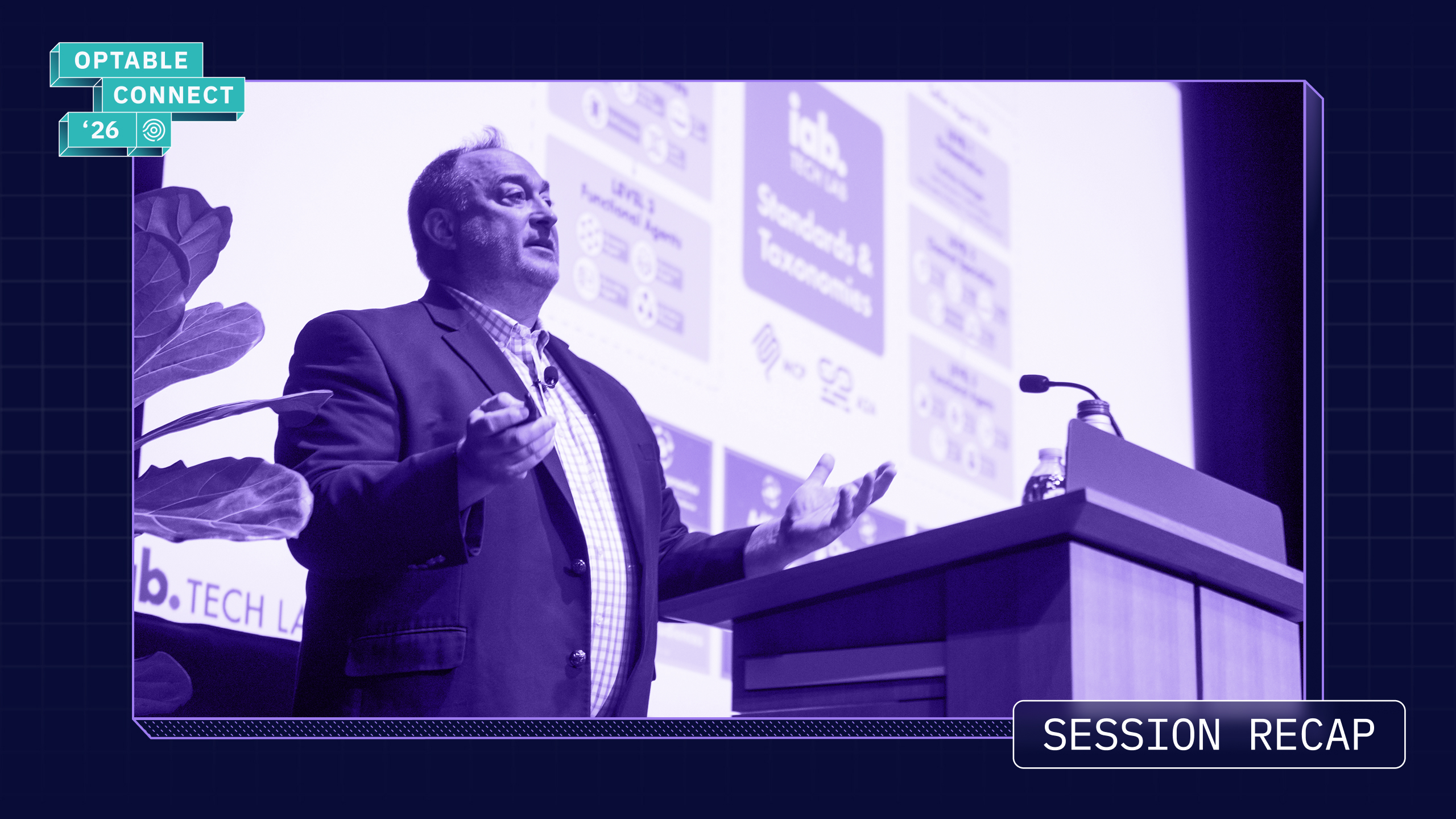
Programmatic scaled because the industry agreed on shared rules for how machines buy and sell. Agentic advertising needs the same kind of buy-in. Katsur explained that IAB Tech Lab's Agentic Ad Management Protocol (AAMP) was developed to build on existing standards and taxonomies rather than replace them, and that agentic standards are being built to support both direct and programmatic buys. IAB Tech Lab is also building an agent registry to add trust and transparency to agent-to-agent transactions.
Nicol brought the view from a major media company. "We're in an industry built on great standards," he said, calling them "the building blocks of success." For media companies, he added, agentic advertising is the first real opportunity to innovate in a long time.
The alternative set of standards is AgenticAdvertising.org's Ad Context Protocol (AdCP); rather than retrofitting programmatic standards, AdCP provides all-new open standards for agentic discovery, planning, buying, selling, and measurement. Regardless of what set of standards gains the most traction, the truth is that interoperability is key.
Katsur also posed the timing question directly: is it still early, or does the industry need to align now? Nicol's advice for the room was to ask how automation and AI are built into their vendors' product roadmaps.
Want to learn more about agentic advertising for your business? Schedule a meeting with our team.
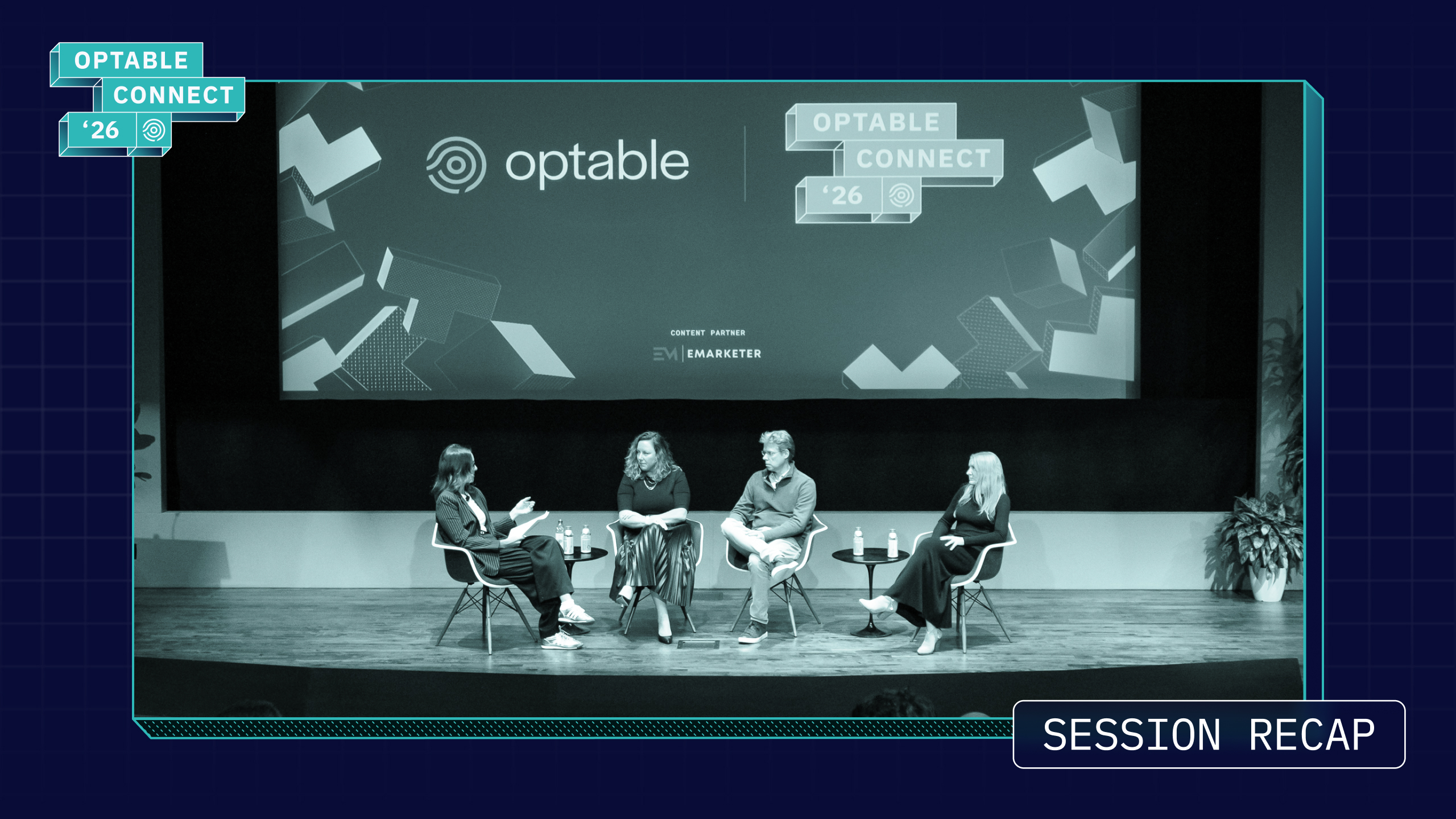
A publisher's most valuable audience signal can be the hardest thing to sells. It thrives in direct deals and custom builds because it was never packaged in a form a buyer could act on without a phone call. Pinterest's commercial intent across visual search and shopping, the trust of Hearst's readers and viewers, and Mediavine's contextual data are incredibly valuable in direct deals. But as buyers start sending agents instead of RFPs, those signals become even harder to monetize.
The panelists agreed that flattening their audiences and signals into simple labels like "sports" or "lifestyle" strips out the context buyers actually want. "It's about merchandising your inventory," Amanda said, so buyers can pick and choose.
Heather described AI as "a copilot, not on autopilot," and urged publishers to understand what their data is telling them and make it readable for agents. Dave called moving a complex RFP process to agentic a data foundation challenge, and described that foundation as ongoing work rather than a destination.
The panel's shared advice: invest in your data foundations now. As Amanda put it, publishers leaning in could see an opportunity they haven't had in a long time, and both sides of the market stand to benefit.
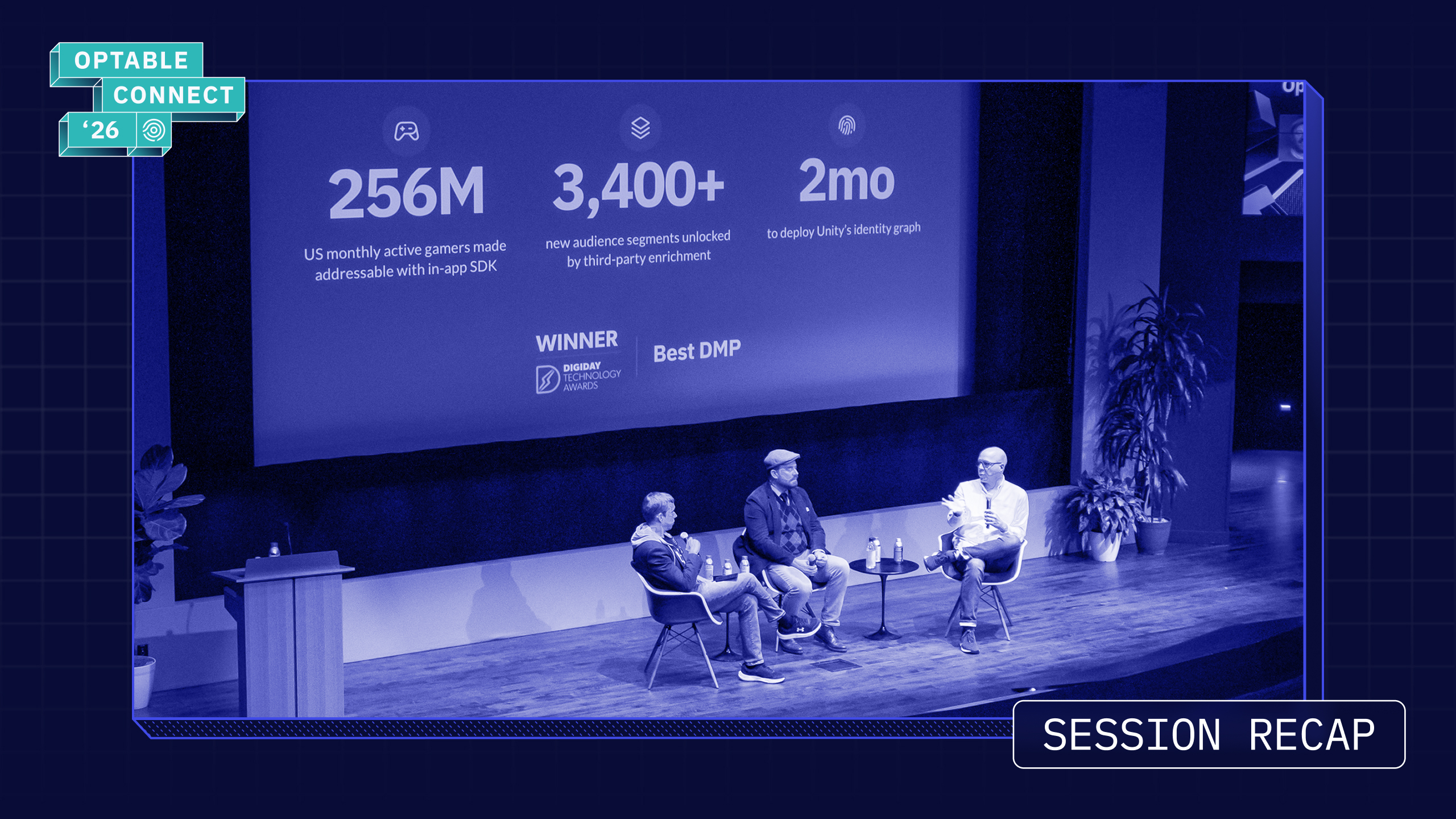
Gaming has the audience brand advertisers want and almost none of the addressability they expect everywhere else. Reaching players has meant separate buys on separate terms, outside the rest of the media plan. Unity set out to close that gap without moving player data out of its own environment.
James framed addressability as the way to future-proof the business: "Without stable addressability, that sense of value creation isn't going to be as strong." Once Unity's player base was resolved into an audience brands can plan next to their CTV and web buys, the door to a new measurement approach also opened.
That foundation makes agents useful. A person can only weigh so many signals, James noted, while a model "can consider a much, much wider set of audiences." Unity uses Optable Audience Agent to build segments that way rather than relying on intuition alone. Bora described AI as a companion that depends on what it's given: "You have to provide clean data and enough context to the model."
The takeaway for publishers and platforms with large but hard-to-address audiences is about sequence. Organize and orchestrate your data on purpose-built infrastructure first. Scaling agents on top of it gets much easier.
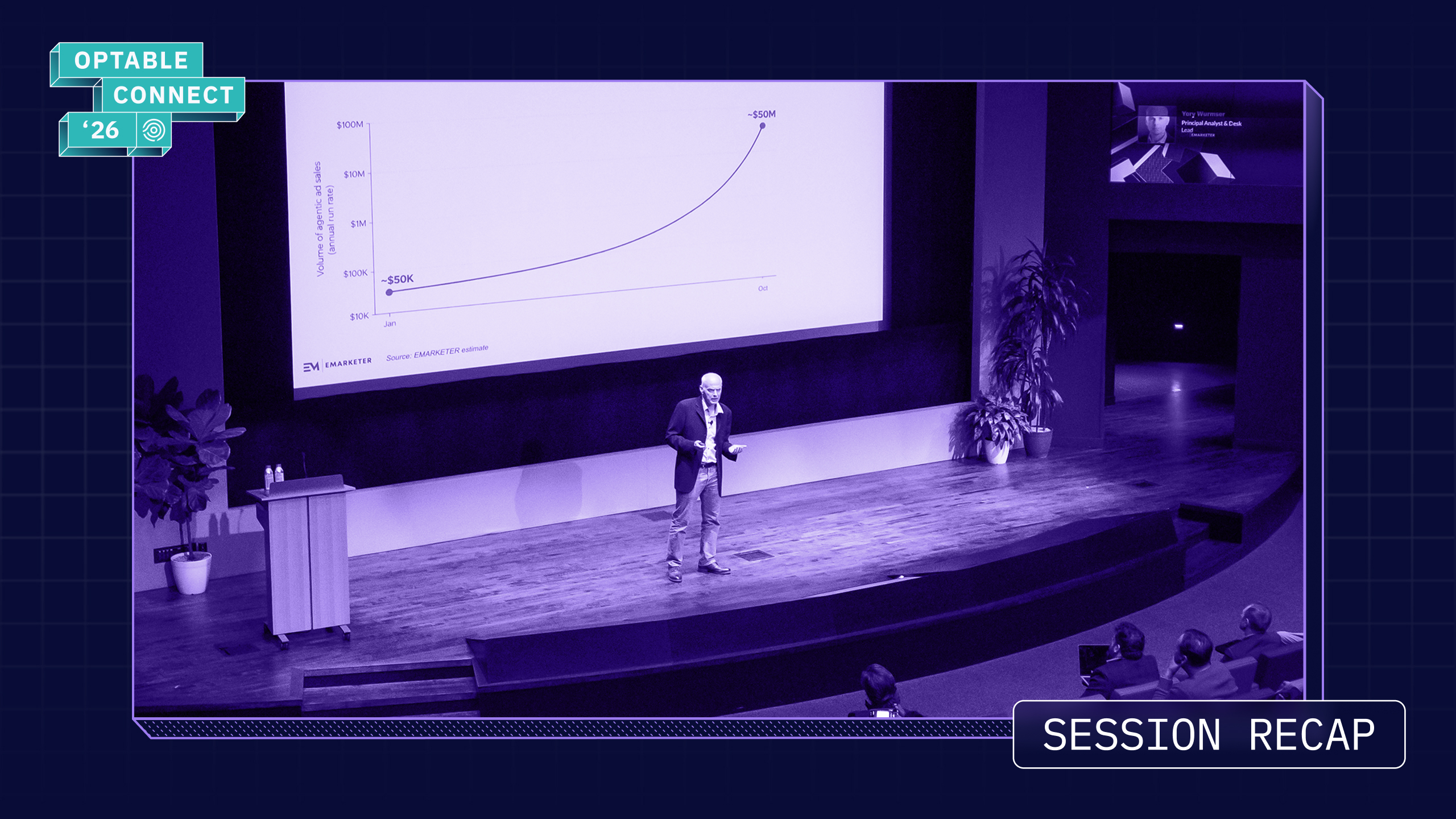
AI is already changing how media gets bought: ads are appearing inside chat interfaces, open-web traffic is shifting toward premium publishers, and buyers are starting to hand campaign work to software agents. This session brought an analyst's view to a day of practitioners, using EMARKETER's forecasts to size what's coming.
Yory opened with how AI advertising will benefit, and even create, walled gardens. As an extension of direct demand, agentic advertising can level the playing field for smaller players. Agents can also make programmatic itself work better, with richer signals, faster decisioning, and more transparency, and agents can negotiate time-sensitive and real-time inventory that's hard to sell today.
On standards, Yory contrasted two approaches. AAMP began as an evolutionary path by bringing agents into programmatic and media planning. AdCP began as a revolutionary approach, with a reimagined workflow across the whole ad stack. Because the two increasingly overlap, he argued, the bigger priority is interoperability, not which set of standards wins.
He projected a large increase in agentic ad spend by 2028, while noting that behavior changes slowly. His four steps to prepare: get specific about what you want from agentic in your goals and briefs, set clear governance rules, organize your data so agents can use it, and experiment.
Digital Content Next (November, 2026) — In 2020, DCN reported on a study that put a number on what many publishers had long suspected. ISBA and PwC traced programmatic spend from advertiser to publisher and found that publishers received just 51% of it. Despite a push for transparency from both sides, the structure hasn’t improved much over time. An open-market buy still passes from agency to DSP to exchange to SSP, with data, identity, and verification vendors along the way. Every hop is an additional cost, taken from the publisher’s share.
Now, the industry is building its first new way to transact since programmatic. Agent-to-agent buying could shorten the distance between buyer and publisher, or it could add a new toll at every step. Which one we get depends on the terms being set right now, while the market is still small enough to shape.
In agentic advertising, we can return to a simpler standard: a seller, a buyer, and a direct connection between them.
How we got here
Programmatic solved many problems in media buying. SSPs let publishers sell supply at scale, and DSPs gave buyers one place to manage spend. Every layer that followed, for data, identity, verification, and measurement, fixed something else.
Individually, these solutions added value. Stacked together, those solutions became a toll road, with every vendor between buyer and seller taking its share.
Direct deals at programmatic speed
Direct deals have always depended on conversations: buyers explaining what their campaign needs, and publishers explaining what their audience and content can deliver. This approach leads to strong campaigns, but it’s also why direct deals take so long to finalize.
For most campaigns, a week or more of emails, RFP responses, and manual planning isn’t worth the effort, so the budget goes to the open exchange instead.
Agentic buying cuts the back-and-forth down to minutes while keeping the buyer and seller in direct contact. Here’s how an agentic direct deal works:
- Share the brief. The buyer’s agent sends a campaign brief to a publisher’s seller agent, outlining the buyer’s objectives and requirements.
- Discover relevant ad products. The seller agent matches the brief to the publisher’s ad products—combining inventory, data, and pricing—and returns one or more options for purchase.
- Select the buy. The buyer chooses which ad products to purchase (a human-in-the-loop activity today), and the buyer’s agent communicates that selection to the seller agent.
- Review and approve. The proposed order goes to the publisher’s team for human review. The team evaluates the terms and approves the buy if they are acceptable.
- Book the order. Once approved, the seller agent books the order into the publisher’s own ad server.
What comes out is a direct IO that moves at programmatic speed, with fewer intermediaries.
Or the same tolls at machine speed
None of that is guaranteed. Nearly every intermediary in the programmatic chain is building an agent of its own. If each one sits between buyer and seller, the deal picks up more fees, collected even faster than before.
The new tolls just look a little different:
- A take rate on what the publisher is paid
- A charge for every brief answered or task completed
- Activation fees to put audiences or inventory in front of buyer agents
- Clearing fees deducted from the publisher’s payout
Together, they rebuild the same stack of fees inside a new interface.
The first platforms to scale will set the defaults for how agentic deals are executed and priced. Publishers have seen this before: programmatic’s fee structure was standard long before they had the leverage to question it.
What fair agentic economics should look like
Standards bodies like AgenticAdvertising.org and IAB Tech Lab are working out how agents should talk to each other. How the money moves is up to the market. Publishers can help set those terms by holding platforms to principles such as:
The deal stays direct. Any platform that places itself between them should be able to say exactly what it adds to the equation and justify what it charges.
Platforms charge for software, not a share of the deal. A marketplace that takes a percentage of every transaction earns more as deals get bigger, whether or not it does more work. Pricing the platform as a service keeps the deal value with the people who create it.
The agent answers to the publisher. An agent paid on spend or take rate works for its operator. A publisher’s agent should carry the publisher’s prices and rules, and nothing should go live until a person approves it. When we surveyed 105 attendees at Optable Connect, two-thirds said they want agents to negotiate and prepare orders, with people approving the final buy.
The buy-side won’t wait
Publishers aren’t the only ones who want better, more direct deals. Independent agencies like Goodway Group are prioritizing direct publisher connections and trimming SSPs as part of supply-path optimization. Some buyers are already deploying buyer agents to transact on their behalf.
What that means is that buyers aren’t waiting for publishers to see the money first. Publishers who build now will help shape how agentic deals get done.
A direct model protects what this business has always run on: relationships. When buyer agents and seller agents talk, buyers and sellers are talking, too.
The next era of advertising
The value of agentic advertising comes from removing the distance between buyer and publisher. That’s why we launched the Optable Agentic Marketplace in October, with a 0% take on direct deals between buyers and Optable seller customers, that provides buyers a single connection point to connect to multiple seller agents.
For publishers, the first step is small. Pick one high-value package, price it, and put it in front of a buyer agent. Then look closely at how much of the buyer’s spend reaches your ad server compared to an equivalent buy through another channel.
The new standard should be the one the industry started with: direct connections between buyers and sellers, now possible at scale through their agents, with fewer intermediaries and better data between them.
Earlier this year, Optable ran the State of Agentic Advertising survey with Digiday and found that more than half of publishers cite internal readiness as a barrier to agent-driven demand, second only to technical complexity.
The technology itself gets most of the airtime in agent readiness conversations. Yet an agentic deal moves through Ad Ops, Revenue, Data Engineering, Legal and Product, and it stalls wherever ownership is unclear. We created the Agent Readiness Self-Assessment & 90-Day Plan to help teams of all sizes identify where they stand today, with a phased plan to close the gaps.
The Roadblock is Coming From Inside the Organization
Agentic deals can run as direct orders or programmatic deals, so they depend on teams that usually work on separate tracks. A single request from a buyer agent can touch packaging, pricing, audience data, and consent at once. Buyer agents evaluate multiple publishers at the same time and may commit to the fastest credible option. A request that waits on a manual handoff between teams risks going to another publisher.
That makes response speed an organizational question as much as a technical one. The primary hurdles to overcome:
- Knowledge and ownership sit with too few people. Unprepared teams may only have one or two people who understand agentic AI and no shared ownership. Every handoff between Sales, Ad Ops, and Data runs through those few people, and work stalls when they’re busy or away.
- Legal questions remain unanswered. In the State of Agentic Advertising survey, 37% of publishers cited regulatory or compliance uncertainty as an obstacle to agentic adoption. Without a clear answer on consent for agentic data exchange, deals get stuck.
- Training hasn't been funded. The same report concludes publisher teams likely need more education to win internal buy-in and resources. Respondents ranked education and organizational change among the least-invested areas.
- Bandwidth is stretched. Many publishers are rebuilding data infrastructure while core revenue is under pressure, and there’s only so many hours in the week. Adding headcount to tackle the project may not be an option, especially for smaller publishers.
Without training, knowledge stays concentrated. Without clear owners, a stretched team can't decide which hurdle to clear first. Deciding on ownership is where your organization needs to start.
No Team Gets To Sit This One Out
An organization that isn't ready only has one or two people who understand agentic AI, no shared ownership, and workflows that are mostly — if not fully — manual. In an agent-ready organization, every team knows its role, responsibilities are defined, and Sales and Ad Ops use agentic workflows as part of their routine.
Here's what readiness asks of each team:
None of these roles work in isolation. Readiness requires a cross-functional team with clear ownership, responsibilities, and mutual understanding.
Let Agents Tackle the Legwork
When agents take over research and setup, people can prioritize strategy, judgment, and approval.
The Weather Company shows how that split works in practice. Its agents handle audience discovery, linking real-time weather conditions to consumer behavior, while the team provides final verification for accuracy and brand safety. Benny Pang, product leader for audience data, calls the agents “a force multiplier.”
Turnaround times shrink as well. At Connect, Goodway Group described going from a client brief to audience segments in under an hour, compared to days or weeks when tackled manually.
For publisher teams, the change shows up in where the hours go. Ad Ops spends less time on manual setup and more time on the deals that perform. Sales packages audiences faster and answers RFPs with more precision. The time that’s freed up gets allocated to direct deals, new audience packages, and partner relationships.
People stay in the loop. Two-thirds of Connect respondents want agents to have more room to negotiate and prepare orders, with humans getting the final say. Where exactly that line sits is a decision each publisher will need to make.
From Kickoff to Agent-Ready in 90 Days
Ninety days is enough time to get to a working pilot with named owners, early results, and agreed rules. Jumping straight to adopting new technology tends to backfire. Without a shared foundation, an agent can end up pitching audiences nobody vetted at prices nobody approved.
The plan below runs in three phases. Each one names who leads, what to do, and how you'll know you're ready for the next phase.
Day 1 to 30: Assess & Organize
Data Strategy and Product lead this phase, with Ad Ops, Revenue, Legal, and Data Engineering playing their parts. As part of this phase, be sure to:
- Stand up a cross-functional working group and give it decision rights over the readiness plan. Book a recurring meeting before the first one ends.
- Record where you’re starting. Document authenticated traffic, addressability, enrichment coverage, and how long RFP responses take today.
- Identify and rank your organization’s gaps by impact. Assign someone to each one.
- Map your current integrations against the agentic frameworks your partners support.
You’re ready to progress when every gap has an owner, you’re written down your baselines, and the group is meeting on a regular schedule.
Day 31 to 60: Build & Activate
Ad Ops and Data Engineering take ownership during this phase, with Revenue shaping what gets tested and Legal reviewing. During the second phase, prioritize the following:
- Choose one pilot segment amounting to a single property, audience, or deal type that Revenue believes buyers want.
- Agree on scope, timeline, and success criteria so every team measures the same thing.
- Record content metadata and taxonomy; clean it up for the pilot inventory, and document the changes.
- Work with at least one partner that can activate both direct orders and programmatic deals, then set up your agent to surface the pilot audiences.
- Maintain a control group from day one. Compare results against your baselines each week.
You’re ready to move onto phase three when your pilot is live, the control group is clean, and you have early numbers to review.
Day 61 to 90: Sell Agentically
Revenue Strategy and Data lead the third phase, tapping Ad Ops and Legal for support. During this phase, you’ll need to:
- Decide how your seller agent represents you. That might include which audiences it surfaces, how it describes inventory quality, which deal types it puts first, and how it answers buyer questions.
- Write governance policies for security, accuracy, transparency and consent, and push them through legal review.
- Report agentic-sourced revenue as its own line so leadership can see what the pilot produced.
- Train each role on its part of the workflow. Practical use cases might include setting guardrails, validating outputs, and knowing where human judgment still has a role.
- Pick the next segment to bring into the program.
You can start scaling when you’ve configured your seller agent, policies are approved, agentic revenue shows up in reporting, and each team has been trained on its role.
Start By Getting Everyone in the Same Room
An agent-ready organization doesn't need every answer on day one, but it does need a plan to educate and empower your people before you can start transacting agentically. The technology matters, but it performs only as well as the teams running it.
Buyer agents are already comparing publishers on how fast and how clearly they respond. The publishers those agents return to will be the ones whose teams can speak for their inventory without a week of internal handoffs.
Optable Audience Agent gives Sales and Ad Ops turns a client brief into audience segments your team reviews. When you're ready to sell, Optable Sales Agent represents your inventory to buyer agents, and the Agentic Marketplace lets them place orders directly while you keep control of pricing and approvals.
If you're working out where your teams should start, schedule a meeting and we can walk through it with you.
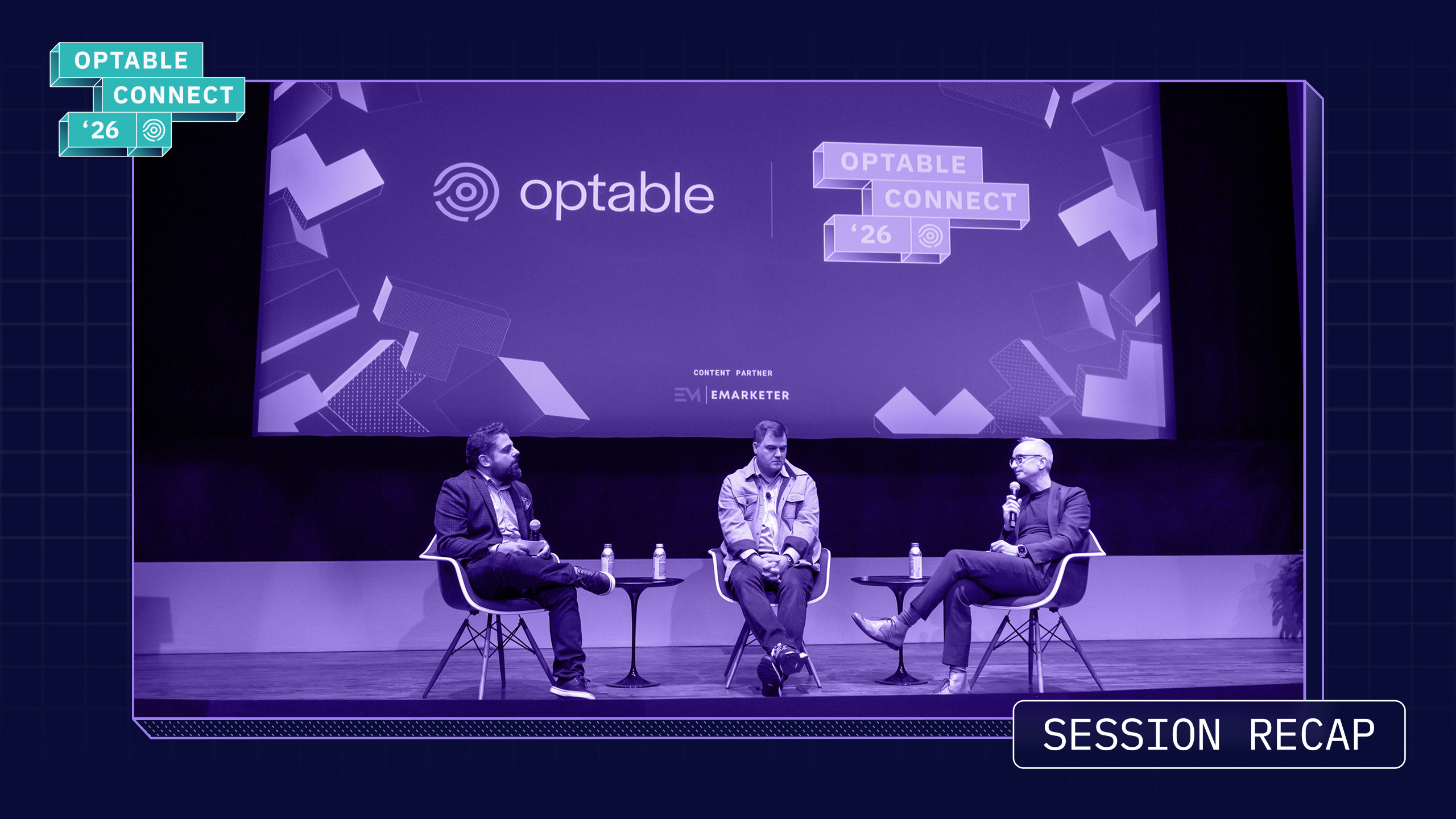
Programmatic proved machines could buy media in real time at enormous scale. It also squeezed publisher yields, added middlemen who never left, and gave buyers a supply chain they couldn't see into. Agentic buying is a chance to scale direct and programmatic transactions, and this panel asked what that will take.
"Programmatic was a huge innovation," Rio said, crediting it with faster transactions and automated planning. But "things haven't gotten better for publishers," because incentives were never aligned. Bosko named what was lost along the way: the best campaigns combine what a brand knows about its audience with what a media company knows about its context, and buying from a "soup of impressions" left no room for that conversation.
The panel agreed that agentic stands to restore relationships. "Agentic is about these buyer and seller conversations," Anthony said. Agent-to-agent communication can route around the middlemen and make deals more transparent. Agents aren't limited by human memory when they assemble an RFP response, and they can do it more efficiently than the manual process publishers have traditionally relied on. Humans still have the final say.
Behavior changes slowly, there's no wholesale disruption yet, and "there is AI in every pitch," as Rio expressed. Bosko's next step for the industry was interoperability, so agents can talk to each other regardless of which protocol is used.
Subscribe to our newsletter