
Updated July 23, 2026
Identity resolution is the process of matching disparate user data from websites, applications, and streaming platforms to form a cohesive, privacy-preserving view of each individual. Relying on siloed first-party data and declining third-party cookies has never been enough for the most accurate, relevant targeting, and that is especially true today.
Factors affecting the fundamental shift in how publishers and media owners collect and use audience information include:
- Shifting privacy regulations
- Increasing user activity across devices and channels
- Declining use of third-party cookies
- Browser technologies limiting cross-site tracking
- Rising numbers of AI agents transacting on behalf of buyers
Without a way to connect that data, publishers see only disjointed snapshots of each visitor, making it nearly impossible to understand the end-to-end journey, attribute conversions, or give an automated buyer anything reliable to act on.
These challenges call for a dedicated approach to connecting fragmented data while preserving privacy. Identity resolution is both the strategic solution and an opportunity for publishers to gain a competitive edge.
Benefits of Identity Resolution for Publishers
Reliable identity resolution allows publishers to more accurately recognize and track visitors across sessions, browsers, and devices, even when traditional identifiers are unavailable.
For publishers, a more unified view of their visitors unlocks a holistic understanding of their audience so they can:
- Reduce data fragmentation and minimize signal loss by recognizing the same visitor across apps, platforms, and anonymous sessions
- Tie interactions together across sessions and devices for a more relevant and personalized content strategy based on interests and behaviors
- Foster stronger, more personalized audience relationships grounded in trust by enforcing privacy, governance, and compliance standards
- Forecast and analyze advertising inventory more accurately with demographics, behavior, and intent data
- Combine identity graphs with data clean room technologies to build customized ad campaigns without exposing raw user data
- Optimize ad targeting and audience activation strategies by using first-party signals to recognize high-intent users and improve conversion paths
- Increase programmatic deal volume and direct-sold advertising with guaranteed reach to known, high-value users
- Diversify monetization across advertising, subscriptions, and affiliate revenue by matching offers to the right audience segment
- Prioritize resources around the most engaged or highest-value segments
How Does Identity Resolution Work?
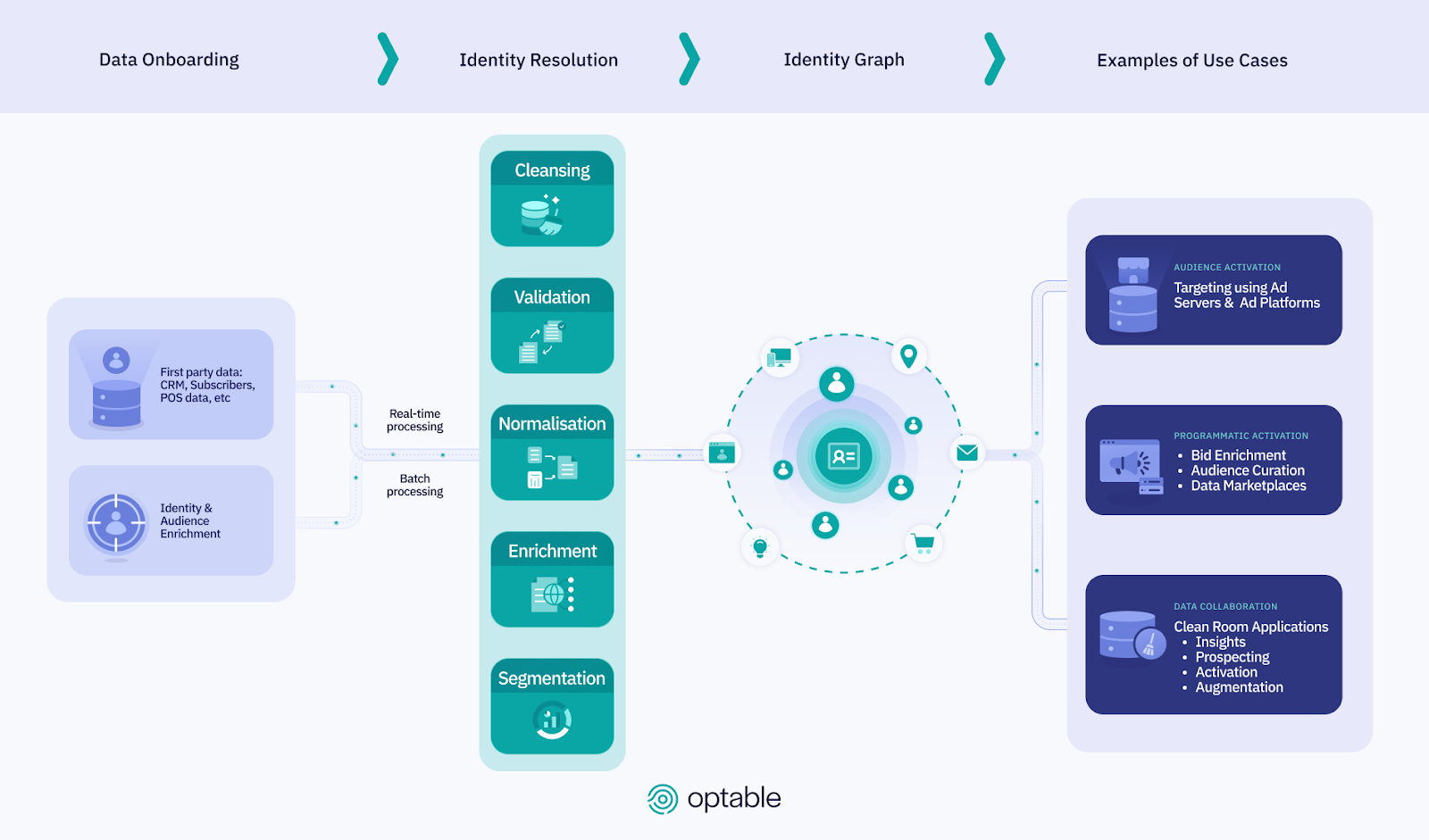
Identity resolution combines data collection, profile unification, and real-time recognition for more personalized experiences and smarter ad targeting.
Data Collection and Ingestion
Identity management begins with collecting deterministic identifiers and probabilistic signals from multiple touchpoints, including owned platforms like websites, apps, and CRMs, as well as data warehouses where visitor data may live.
Deterministic identifiers are explicit, verifiable pieces of information directly linked to individuals; they include email addresses, phone numbers, and audience IDs. These identifiers offer high accuracy for matching and identity resolution, but they can be challenging to scale due to their limited availability.
Probabilistic signals provide likely but unverified matches to user identities; examples include device types, IP addresses, browser versions, and behavioral patterns. Collecting and applying these signals enables broader coverage and faster scaling of identity graphs, but with less precision than deterministic methods.
After collection, all data gets ingested into centralized systems like CDPs, where identity resolution takes place. The combination of deterministic and probabilistic data allows organizations to construct unified visitor profiles from both authenticated and anonymous traffic.
Profile Unification
Once anonymous identifiers like device IDs and IP addresses are linked with known signals like login credentials and email addresses, the data is merged into individual profiles. These profiles consolidate demographic information, behavioral insights, and engagement history across channels.
Profile unification enables the creation of a golden record, which is a single, consistent version of visitor data that all internal systems can access and update in real time. This unified profile eliminates data silos and provides a 360-degree view of each user.
Activation and Real-Time Recognition
Identity resolution often uses advanced algorithms and machine learning to connect scattered data points to the right individual, building a more complete understanding of their behavior across devices in real time.
Modern identity resolution platforms allow publishers to instantly identify visitors as soon as they interact with a website or app. This real-time recognition unlocks the potential for immediate, tailored experiences that reflect each visitor's journey.
These platforms seamlessly integrate with automation tools, customer data platforms (CDPs), and advertising systems for convenient activation, allowing organizations to orchestrate consistent messaging and cohesive experiences throughout the entire customer journey at every touchpoint.
From initial collection to identity graph activation, each phase depends on the same underlying structure to link a visitor's signals together: the identity graph.
So, What Is an Identity Graph?
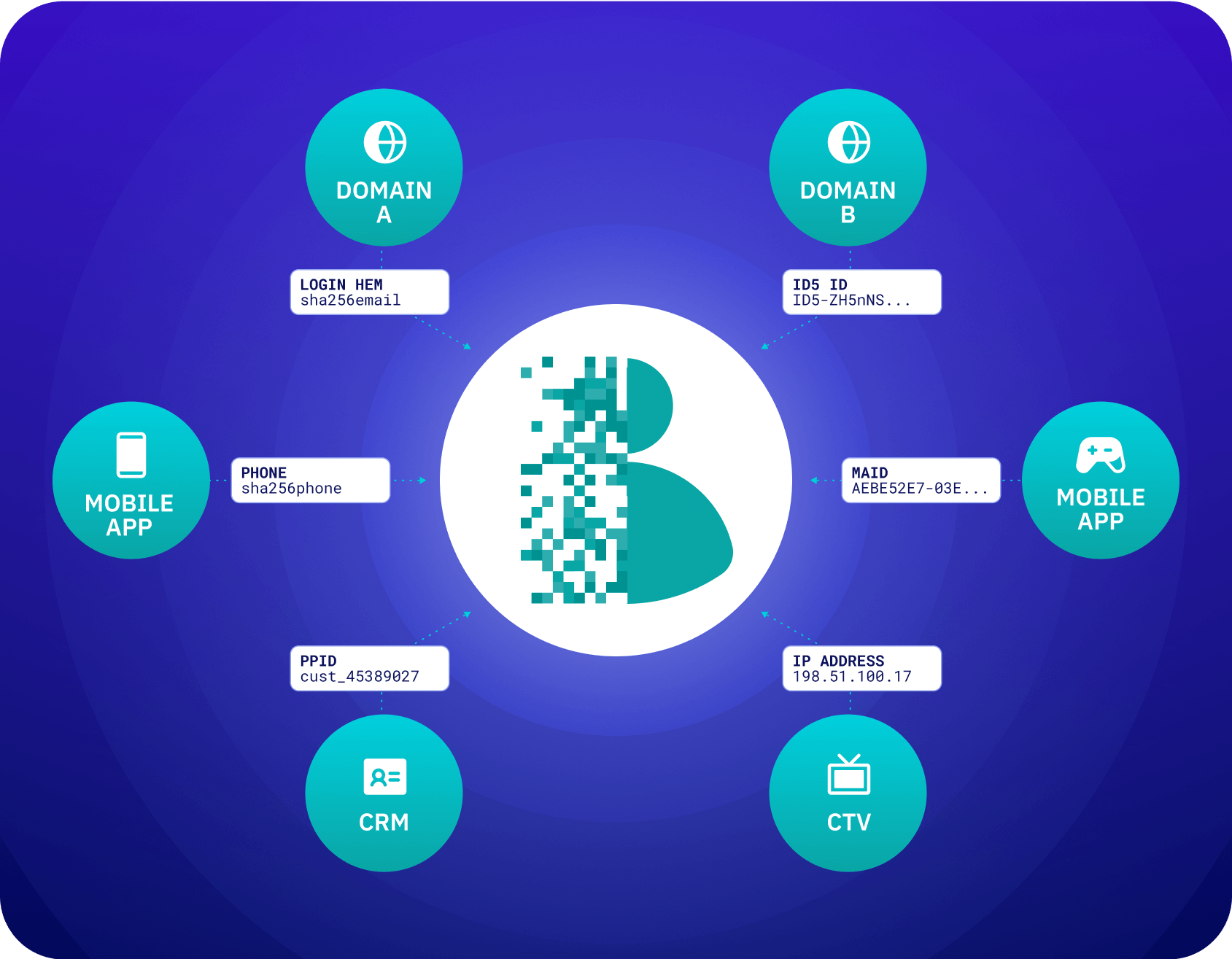
An identity graph is a dynamic database that stores relationships between known profiles and additional identifiers, connecting multiple data points to a single identity using a combination of exact and probabilistic matching.
Identity graphs evolve as new data is collected and as users interact with different platforms and devices. Continuous updates and optimization processes ensure that the identity graph remains accurate and compliant.
It's worth distinguishing two terms that may get used interchangeably. Identity resolution is the ongoing work of collecting, matching, and updating signals tied to a person. The identity graph is the output of that process, resulting in a structured, queryable record of those matched relationships.
As buying shifts toward AI agents that autonomously evaluate and transact on inventory, those agents need a reliable answer when they ask who a visitor is and what a publisher knows about them, in the time it takes to place a bid. An identity graph gives them one.
What Does Identity Resolution Software Do?
Identity resolution software is the technology layer that:
- Ingests visitor data from multiple sources
- Applies deterministic and probabilistic matching to link identifiers to a single profile, and
- Organizes the results into an identity graph that other systems, including buyer agents, can query in real time.
The software handles jobs a publisher's team can't reasonably do by hand: deduplicating and merging records as new signals arrive, resolving anonymous and authenticated traffic into the same profile, and pushing updated identity data to ad servers, CDPs, and personalization engines the moment a visitor returns.
How To Unify First-Party Data Across Channels
Publishers unify data across channels the same way they unify it within any single channel: by collecting deterministic and probabilistic signals from every owned touchpoint, resolving them into an identity graph, and merging the result into one profile.
In practice, that involves connecting data from a publisher's entire ecosystem, including website, app, CRM, email lists, over-the-top (OTT) streaming or CTV platforms, and more. That means a subscriber who reads an article on desktop and plays a game on mobile resolves to the same golden record.
With these cross-platform insights, publishers and advertisers can forgo one-size-fits-all strategies in favor of personalized recommendations and relevant offers based on an audience's interests, behaviors, and purchase history.
What To Look for in Identity Resolution Software
When selecting an identity resolution partner, publishers should look for solutions that offer:
- Seamless data integration: The identity resolution solution efficiently and securely ingests audience data from all sources into a centralized platform.
- Advanced identity graphs: Identity resolution platforms should integrate with dynamic, adaptive identity graphs that enhance each profile.
- ID Framework interoperability: Platforms should work across multiple frameworks and Universal IDs to ensure broader compatibility and scalable partner collaboration across the advertising supply chain.
- Agent-ready interoperability: The solution should surface identity and audience data in formats that humans and AI agents can query directly.
- Ongoing identity matching and maintenance: Modern CDP tools need to continuously remove duplicate data, perform intelligent matches, anonymize sensitive details, and suppress outdated or incorrect entries.
- Source & destination integrations: The solution needs to provide interoperability for frictionless connectivity with external tools and platforms across the marketing and AdTech ecosystem.
- Built-in compliance controls: The platform must safeguard publishers, advertisers, and users with global privacy and security measures that align with data protection standards and regional requirements.
Power Comprehensive Identity Resolution with Optable
Today, publishers need a robust, purpose-built first-party identity solution. Optable provides a resolved identity graph by connecting visitor data from every touchpoint, so publishers can activate audiences in real time and monetize with confidence.
That same agent-ready identity foundation powers Optable Audience Agent. Publishers can upload an inbound RFP, and the agent compares the request against the audience data in their identity graph. The agent surfaces segments worth building and proposing, cutting down on the time and labor a manual search has historically required.
Schedule a demo to see what a resolved identity graph could do for your next RFP cycle.