
Originally published on LinkedIn
For the last decade or more, audience planning has lived on the buy side: in programmatic platforms like DSPs, DMPs, and licensed audience-graph tools owned and operated by marketers. Brand managers and planners build audience profiles, forecast reach, and model spend inside tools like DV360, The Trade Desk, and Amazon DSP where the activation actually happens.
The challenge is these platforms have slowly been reducing their holistic visibility into audience data as the promise of a large, open auction for all digital audiences fades away and fragments from new innovation. That said, before programmatic planning happened in spreadsheets, with publishers doing meaningful research, packaging insights, and meeting buyers where they were thinking about audiences.
A lot of linear TV and terrestrial radio still works this way: large research organizations on the sell side provide demographic, behavioral, and contextual insight directly to advertisers as part of the proposal process. We're not talking about hyper-niche attributes like "left-handed golfers in Wisconsin," but structural ones like age, gender, income, location, and household composition.
Agentic media buying is going to swing the pendulum back in that direction.
What Audience Planning is All About
Audience planning is actually two functions that are going to become increasingly intertwined.
- Audience construction: Who are we trying to reach, what attributes define them, and what data sources support that definition.
- Forecasting and allocation: Against that audience, what inventory exists, what does it cost, and how we sequence spend to deliver outcomes
Today, both functions have been pulled into buy-side platforms. Buyers love this because it's one tool and one workflow with a single log-in.
The trade-off, which usually goes unacknowledged, is that buy-side audience planning relies on data that has been hopped, modeled, and matched several times before it lands in the planning surface. As cookies deprecate, MAIDs decay, and identity fragments further, data quality keeps quietly declining.
Where the Sell-Side Comes In
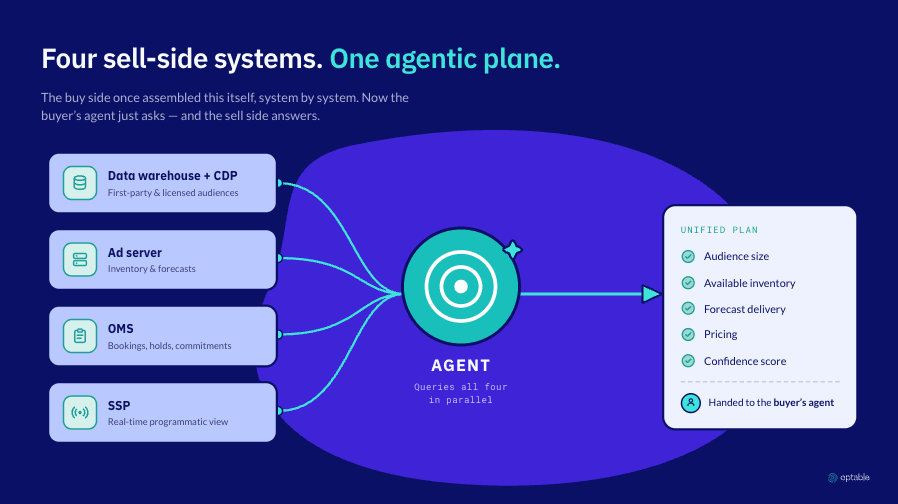
The simple truth is this: Sellers have always had better raw data. The problem is that the data lives in different systems that are hard to plan against in a unified way:
- A data platform or warehouse holds licensed research data.
- A CDP holds first party audience insights.
- The ad server holds available inventory and forecasts.
- The OMS holds bookings, holds, and direct-sold commitments.
- The SSP holds the real-time, programmatic market view.
Responding to an RFP means looking across all four. Most sellers don't have a single tool that brings them together; they might have a planner, SQL queries, and a spreadsheet. That fragmentation has made it nearly impossible for the buy side to deliver a quality planning experience to advertisers.
What Agentic AI Brings To the Table
Agentic workflows are built for this.
Consider what an inbound RFP looks like now versus what it could look like with an agent in the loop.
A buyer sends a brief that includes target demographics, interests, platforms, budget, and timeline. Traditionally, that brief sits with a team that:
- Builds the audience against the publisher's both first-party and licensed data.
- Checks the ad server for forecasted impressions against that segment.
- Pulls the OMS to see what's already committed against the same inventory.
- Queries the SSP for programmatic backfill.
It might take multiple people several business days to tackle the assignment. The audience definition can get simplified along the way because custom segments are too expensive and labor-intensive to build by hand or the forecasting is too hard to analyze.
But in an agentic workflow, the brief comes in, and the agent queries the four systems in parallel before recommending audiences from first-party data based on the buyer's parameters. It will then return a plan with audience size, available inventory, forecast delivery, pricing, and confidence scores in a fraction of the time it would take otherwise.
The audience proposal matches the brief instead of getting flattened to fit what the planner can manually build, and the team has more time to dedicate to strategy. Everybody wins.
Why All of This Matters
When that capability gap closes, the publisher's structural advantages reassert themselves:
- The data is proprietary, first-party, and licensed or matched at the source.
- Inventory forecasts come from the system of record, not approximations.
- Pricing and availability reflect true commitments instead of market guesses.
- Cross-format planning (direct, programmatic, curated) becomes coherent.
A publisher that can respond to ten RFPs in the time it used to take to respond to three, with audiences built to order instead of approximated, becomes a valuable partner to the buyer. The streamlined planning experience that agencies have been getting from buy-side tools becomes available from the sell side with better underlying data.
And the best part is that agentic audience workflows are already being deployed. Publishers can start taking advantage of agentic-empowered audience creation and RFP responses today.
Proof in the CTV Market
To understand the CTV land grab, start with currency. For decades, television ran on one: Nielsen. A single panel produced the numbers buyers and sellers agreed to plan against, transact on, and measure by. Whatever its flaws, it was a shared source of truth for the entire market.
Streaming broke that. No single panel sees across Netflix, Disney+, Roku, Amazon, and YouTube, and each one holds its own logged-in viewing data and reports on its own terms. The shared number fractured into many. Nielsen ONE, Comscore, VideoAmp, and iSpot now compete to measure the same impressions, while the largest platforms increasingly measure themselves.
For a buyer, that means planning a CTV campaign no longer starts with one currency. It starts with reconciling one set of data sources to define the audience, another to activate against it, and another still to measure what happened, most of which disagree. When there is no shared currency, the advantage moves to whoever owns the most trustworthy data and the surface that plans on top of it.
That is what the moves from earlier this year are really about. Look at what happened in the in the last quarter:
- Walmart bought a performance CTV company, Vibe.co and also launched Connect Select, a streaming TV marketplace inside Walmart DSP powered by its Vizio acquisition.
- Pinterest launched a CTV audience-extension product on the back of its tvScientific acquisition, opening its monthly user base to third-party streaming inventory for the first time.
- Meta is reportedly meeting with Magnite, FreeWheel, and TV OEMs about plugging its demand into living-room inventory.
- PayPal launched Curated Ads, putting transaction data into CTV targeting and measurement.
- Roku unveiled Roku Curate, a roster of commerce data partners including Best Buy Ads, Fandango, Criteo, Fetch, Kroger Precision Marketing, and Instacart.
Each of those players is positioning itself to be the audience-planning center of gravity for CTV, and each leads with something different: intent, purchase data, identity, device data, transaction data, and commerce-graph partners. Individually, none of those signals give buyers everything they want. Whichever platforms combine the most signals behind a single planning surface will be the ones that reap the rewards.
This is the same dynamic that played out a decade ago. Meta and Google won because their audience platforms made buying so frictionless that buyers stopped wanting to plan anywhere else. The CTV race is the rerun, but with the sell side better positioned this time, because the data quality and identity advantages live with the publishers and platforms rather than with third-party graphs.
What Happens Next
Data is becoming the great CTV differentiator as inventory commoditizes. The advantage now moves to whoever owns the audience, the data, and the planning surface that sits on top of them.
If the most accurate, highest-fidelity audience planning lives on the sell side, the buyer's job becomes orchestrating across multiple sell-side environments rather than working inside a single buy-side seat.
Three things to watch:
- Which publishers and platforms unify their internal stack behind a single agent-addressable interface, ideally one that speaks AdCP or an equivalent standard. They will be the ones buyers consider essential in plans.
- Which holding companies build orchestration layers across multiple sell-side environments.
- Which large platforms become audience-planning hubs for streaming.
Audience planning has lived on the buy side for a decade because publishers couldn't deliver it at the pace buyers needed. Now, the publishers and platforms that treat audience planning as a core capability, and adopt agentic AI to make it sustainable at scale, will be the ones that buyers plan around.