
.png)
The shift toward first-party data, privacy-by-design systems, and interoperable identity frameworks has reshaped what publishers need from their data infrastructure. Most publishers now face a familiar challenge: they capture audience interactions across web and app environments, but the underlying signals are shallow, inconsistent, or difficult to activate in meaningful ways. Traditional DMPs and the remnants of cookie-based targeting aren’t enough to support modern audience strategy.
This is the gap Merkury fills.
Built by Dentsu Canada and powered by Optable’s clean-room technology, Merkury offers a scalable, privacy-compliant identity enrichment layer that plugs securely into a publisher’s existing ID graph. It is built on a market-specific identity dataset designed for the needs and nuances of Canadian audiences and is available in three tiers: a free “Flash” tier for exploration and overlap insights, a full-featured tier for enrichment and activation, and an enterprise tier for publishers who need continuous, high-volume identity resolution.
The Foundation: Understanding Canadians
Merkury’s dataset isn’t licensed, purchased, or inferred from a smattering of digital sources. It’s built on the largest agency-operated consumer benchmark available: Dentsu’s CCS. For over a decade, primary research on about 20,000 Canadians annually across more than 10,000 attributes has given insight into psychological drivers, decision-making patterns, media consumption, and lifestyle factors that basic signal or transactional data simply can’t capture. From this foundation, Merkury models identity enrichment across 600,000 unique postal codes, giving publishers granular audience understanding at scale.
How Merkury Works
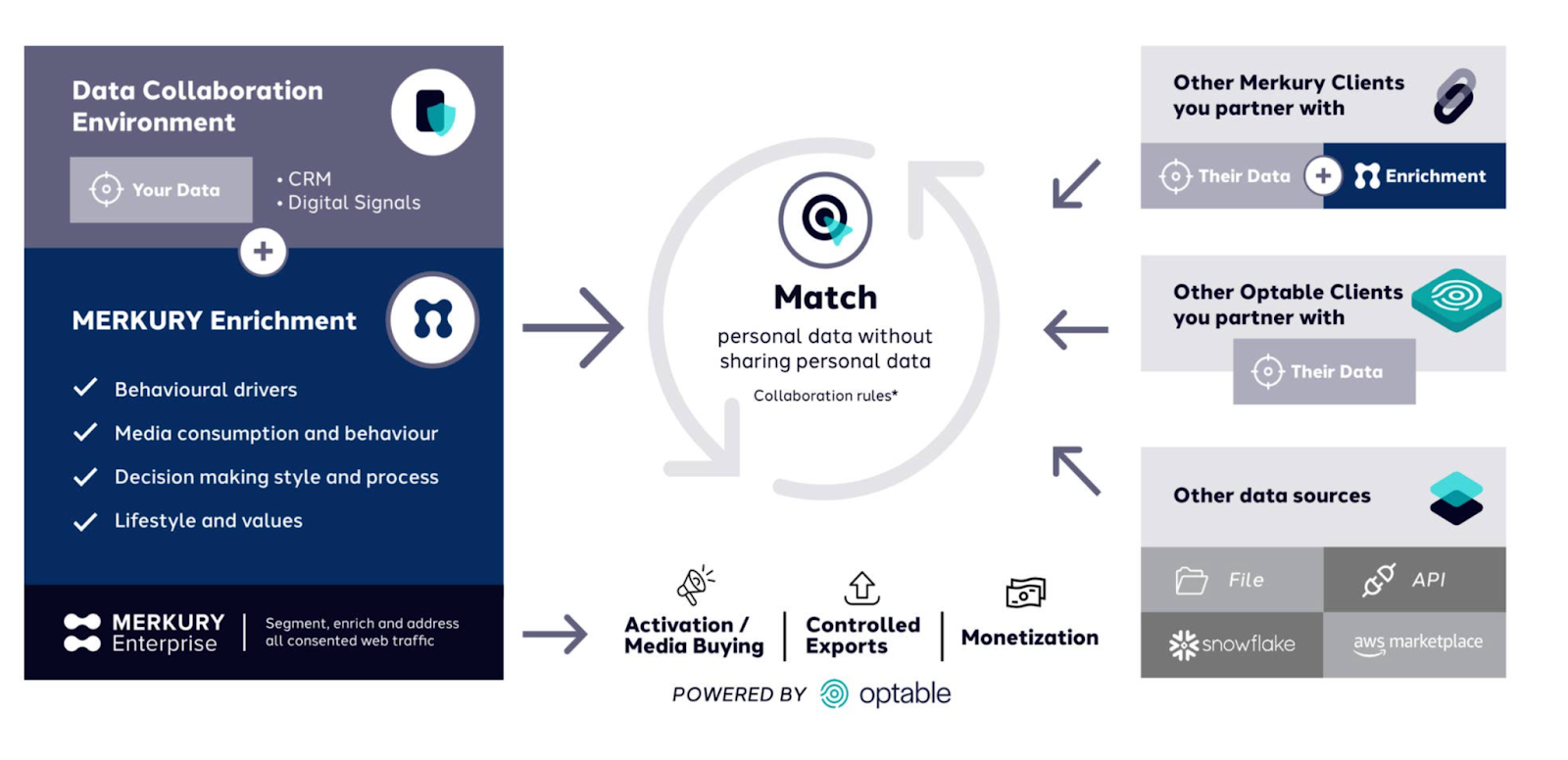
1. Data Ingestion and Identity Resolution
Publishers typically start with fragmented identifiers—hashed emails, mobile IDs, login events, contextual signals, and first-party behavioral data. Merkury ingests these identifiers into Optable’s clean room, where they can be matched against Dentsu’s CCS-derived dataset to create a more complete, privacy-safe identity foundation.
For publishers with large amounts of anonymous traffic, the enterprise “Merkury-as-a-source” tier provides additional value by helping resolve more of that unaddressed audience and incorporating those identities into their own graph for future activation and monetization.
2. Attribute Enrichment
Once identity resolution is established, Dentsu’s Merkury dataset provides access to high-quality behavioral attributes that deepen publishers’ understanding of their audiences. Teams can enrich their internal profiles with traits such as:
- Psychological factors and behavioural drivers
Media consumption patterns and behaviour - Decision-making styles and mindsets
- Personal passions, lifestyle, and values
This enrichment transforms partially known users into meaningful audience profiles ready for segmentation, personalization, and monetization.
3. Seamless Collaboration
Optable’s clean room serves as the backbone of the collaboration layer, allowing publishers to:
- Collaborate with your partner advertisers or other Dentsu or Optable clients
- Support secure audience matching and overlap analysis
- Enhance audience profiles with advertiser-provided traits
- Enable lookalike modelling and reach extension
- Activate high-value, consented audiences
Merkury also benefits from Optable’s multi-partner management capabilities, making it easier to collaborate across many relationships within a single, streamlined environment.
4. Activation Across Channels
Once enriched, audiences can be activated across a buyer’s preferred channels through Optable’s integrations or Dentsu’s media ecosystem. Key activation paths include:
- Real-time activation to DSPs such as The Trade Desk, Amazon DSP, and Google DV360
- Activation to social platforms including Meta, TikTok, and X
- Activation through publisher ad-serving infrastructure like Google Ad Manager and Prebid
Merkury Key Values for Publishers
- Operational Simplicity: Rather than building enrichment, privacy, and activation layers independently, publishers can rely on Optable’s standardized clean-room pipeline for a faster, more efficient path to scale.
- Future-Proofing Against Signal Loss:
- A deterministic identity anchored in their own data
- Enriched profiles that don’t rely on external cookies
- Durable cross-channel addressability
- Audience data grounded in primary Canadian research, not modelled proxies or imported datasets
- Improved Advertiser Alignment: Merkury provides a shared identity structure and a collaborative clean-room environment, making it easier to align with advertiser needs and accelerate campaign setup.
A Modern Identity Infrastructure for Growth
The Dentsu x Optable partnership helps publishers extend the value of the identity data they already own. By combining Dentsu’s decades of understanding Canadians with Optable’s privacy-first collaboration layer, publishers can broaden their audience understanding, strengthen advertiser relationships, and enhance the value of every impression they sell.
Across its three Canadian tiers: exploration, full activation, and enterprise identity resolution, Merkury gives publishers the flexibility to grow at the pace their strategy demands. In a market where every signal counts, Merkury provides a stronger, more complete identity framework to build on.
Contact us at sales@optable.co to learn more about how Merkury can upgrade your data and audience strategy.